
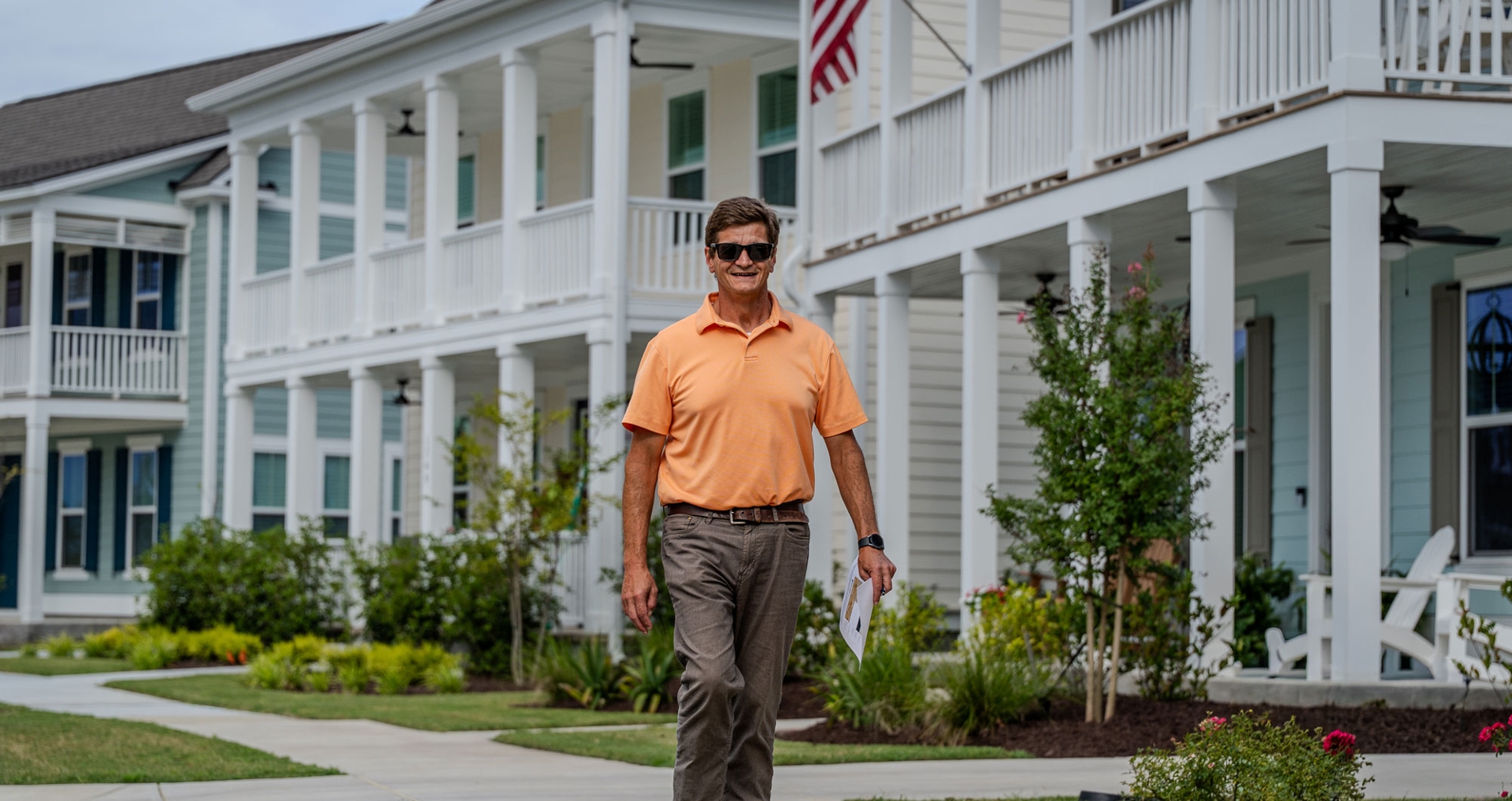
Meet our Development Manager Baird Stewart
Helping to Bring a Long-Term Vision to Life
When Baird joined the Jackson Companies in 2021, he found himself working on something remarkably like the communities that first inspired his career.
The vision for SayeBrook began more than two decades ago. Rather than creating another subdivision, The Jackson Companies’ goal was to build a true traditional neighborhood, a place designed around people instead of automobiles. That means walkable streets, welcoming front porches, thoughtfully designed parks, neighborhood gathering spaces, and a Town Center where residents can shop, dine, and enjoy everyday conveniences just steps from home. "The objective is to create a place for people," Baird says.
Building More Than Homes
When Development Manager Baird Stewart talks about SayeBrook, he rarely starts by discussing homes, roads, or construction. Instead, he talks about people. That's because every sidewalk, front porch, green space, and gathering place has been thoughtfully designed with one goal in mind: creating a community where neighbors naturally connect.
When you drive through SayeBrook, it's easy to admire the beautiful homes, inviting streetscapes, and vibrant Town Center. What isn't immediately obvious is that nearly every detail, from the depth of a front porch to the placement of a neighborhood park, was intentionally planned.
For Baird Stewart, that's exactly the point. "If I've done my job right, nobody knows I was there," he says. "They just know they want to come back." It's a philosophy that has guided his career for decades and now shapes one of Myrtle Beach’s most distinctive communities.
A Career Focused on Creating Places
Long before joining The Jackson Companies, Baird knew he wanted to create places where people genuinely enjoyed spending time. Growing up on a farm outside Philadelphia gave him an appreciation for both the outdoors and thoughtful design. After earning a degree in economics from Denison University, he followed his passion to Louisiana State University, where he earned a master's degree in landscape architecture.
While many landscape architects focus on individual homes or gardens, Baird quickly realized he was drawn to something much bigger. "I liked the master planning scale," he explains. "Thinking about how people enter a site and how they interact with it."
That passion led him through traditional neighborhood projects near Washington, D.C., community planning in North Carolina, and more than a decade working every aspect of residential development—from design and permitting to heavy equipment, utilities, construction, and even home sales. It’s that experience that allows him to approach every project from multiple perspectives.
"I've been in the ditch putting pipe together," he says. "I've operated the equipment. I've built the homes." Understanding every phase of development helps him work alongside contractors, engineers, and builders with a practical knowledge that can't be learned from drawings alone.
Every Detail Has a Purpose
One of the most common questions prospective homeowners ask is why the homesites at SayeBrook are smaller than those found in some other neighborhoods. For Baird, the answer is simple. "It's deliberate."
Smaller homesites allow homeowners to spend less time maintaining large yards and more time enjoying beautifully designed outdoor spaces throughout the community. Instead of spending every weekend mowing grass, residents can relax by the pool, walk to dinner, meet neighbors on the front porch, or gather in one of SayeBrook's many open green spaces.
One of Baird's favorite moments came just months after SayeBrook Park opened. Without any prompting, residents set up a volleyball net on the expansive lawn. "That's exactly what it was designed for," he says. "That's the whole idea." Those open spaces weren't created for one specific activity. They were designed so residents could make them their own—whether that's volleyball, cornhole, soccer, picnics, or simply spending time together.
Designing for Connection
That philosophy extends to the homes themselves. Front porches are built deep enough to be truly usable. Garages are placed behind homes or set farther back whenever possible, so they don't dominate the streetscape. The goal is simple: encourage neighbors to see one another. "We want people to live out of the front of their house," Baird explains. "We want people entering through the front door, sitting on their front porch and interacting with their neighbors."
Even the placement of homes by different builders is carefully planned to create architectural variety while allowing construction to progress in manageable phases, minimizing disruption for homeowners. It’s all part of preserving the original vision.
Seeing SayeBrook Through Fresh Eyes
Every morning before sitting down at his desk, Baird drives through SayeBrook. He's not looking for what looks good. He's looking for what could be better. He enters through different entrances, experiencing the community the same way a homeowner or first-time visitor would. He notices landscaping, construction activity, traffic flow, and the countless little details that influence how the neighborhood feels.
"I'm always looking for problems," he says with a smile. It's this daily routine that helps ensure SayeBrook continues to reflect the same level of care and attention that shaped it from the beginning.
More Than Development
For Baird, success isn't measured simply by the number of homes built or roads completed. It's measured by something much harder to define: the feeling people experience when they arrive. Creating that feeling takes decades of planning, collaboration, and attention to detail. It requires everyone—from engineers and builders to landscapers, inspectors, and homeowners—to share the same commitment to the community's original vision.
"We want to create a place for people," Baird says. "A traditional neighborhood where people interact." It's a vision he has spent his entire career pursuing. And if visitors can't quite explain why SayeBrook simply feels different, but know they want to come back, that's exactly how The Jackson Companies development team knows the design is working.